Most retrospectives are built from memory.
People sit down after a sprint, a launch, or a quarter and try to reconstruct what happened. What slowed us down? Where did work get stuck? Which assumptions were wrong? What should we change before the next cycle?
That ritual is useful, but it is lossy. The most interesting process failures happen in the middle of work: a teammate corrects an instruction for the third time, a model skips a verification step, a permission prompt blocks a long-running task, a stale doc sends the session down the wrong path, or someone pastes the same context again because the tool cannot find it.
AI session transcripts capture those moments with unusual density.
They are not just chat logs. They are behavioral records of how work actually moved. They show the instructions people gave, the assumptions agents made, the tools that failed, the checks that were skipped, the context that had to be reconstructed, and the corrections that kept repeating.
That makes transcript mining a high-leverage habit for AI-native teams.
Retrospectives should not disappear. Humans still need to talk about judgment, trust, priorities, and tradeoffs. But quarterly memory-based retros are too slow for a workflow where agents run every day across multiple tools.
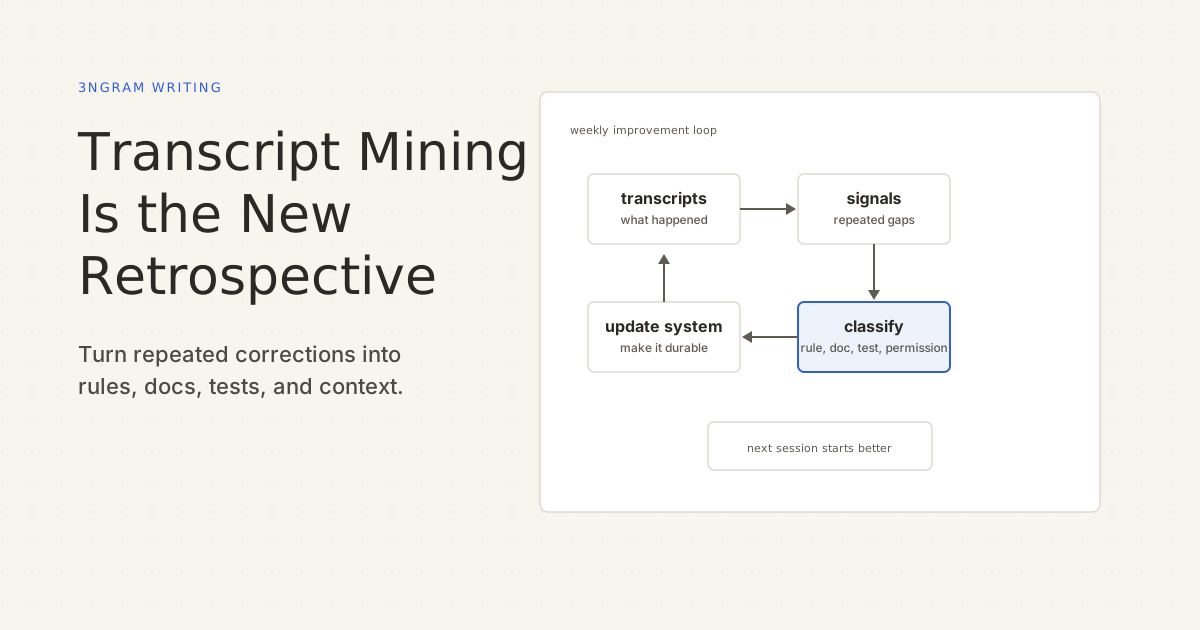
The better loop is shorter:
Mine the transcript, classify the failure, update the system, and make the next session better.
Why Transcripts Matter More Now
When AI is used as a drafting assistant, transcript mistakes are annoying. When AI agents start doing multi-step work, transcript mistakes become process data.
A missed instruction might mean the project guidance is incomplete. A repeated “did you check this?” might mean verification is not encoded where the agent can use it. A permission prompt in the middle of a long task might mean the permission model is too coarse, too risky, or not supported by evidence from prior work.
This matters because the frontier is moving toward longer-running, more autonomous work. In Akash Bajwa’s write-up on the future of software engineering with Anthropic, long-horizon tasks show up as a bottleneck: what do you assign to an agent for several hours, how do you observe it, and how do you keep a human in the loop without babysitting? The same piece points to context management as still unsolved, with human-authored context helping and stale or agent-authored context potentially hurting.
That is exactly the terrain transcripts expose.
If an agent can run for longer, the team needs better observability into how it drifted. If context can help or hurt, the team needs evidence about which context was missing, stale, or too vague. If the human role shifts from doing every step to steering the work, the system has to reduce context reconstruction instead of turning the human into a courier between tools.
Transcripts are where those steering failures become visible.
The Signals To Mine
The most useful mining pass starts with small phrases and repeated patterns.
Eugene Yan makes this concrete in How to Work and Compound with AI. He describes scanning past user turns for phrases such as “can you also,” “did you check,” and “still wrong,” then using those corrections as evidence that a config, skill, or verification step needs to change. The point is important: the correction is not only feedback for that one session. It is training data for the work system.
A practical mining pass should look for signals like these:
- “Did you check…” usually points to a missing verification step.
- “Still wrong” points to a repeated failure, weak test, or vague acceptance criterion.
- “Not what I meant” points to ambiguous intent, missing examples, or an instruction that needs sharper boundaries.
- “As I said earlier” points to context that was available somewhere but not carried forward.
- “Use the latest…” points to stale assumptions or missing source lookup rules.
- “Where did you get that?” points to missing provenance or unsupported claims.
- Repeated permission prompts point to unclear policy, missing allowlists, or risky defaults.
- Repeated tool errors point to missing tooling, environment drift, or instructions that assume unavailable commands.
- Skipped tests, lint checks, or visual checks point to weak verification habits.
- Repeated source-link requests point to a retrieval or citation gap.
Each team will develop its own vocabulary of friction. Legal, support, design, and engineering teams will see different signals.
The pattern is the same: the transcript shows where the human had to intervene because the system did not carry enough context, judgment, policy, or verification forward.
Classify The Finding
Raw transcript observations are too messy to act on directly. The team needs a small taxonomy that turns “this went badly again” into a concrete fix.
One useful classification looks like this:
| Finding type | What it means | Typical fix |
|---|---|---|
| Missing context | The agent did not have the relevant decision, preference, glossary, source link, or current project state. | Update the source index, briefing, memory record, or project context. |
| Missing tool | The agent could not inspect, run, fetch, search, or modify the thing needed to complete the task. | Add an integration, script, MCP tool, or documented fallback. |
| Missing rule | The agent did something the team already knows it should not do, or failed to do something it should always do. | Add or tighten an instruction, repo rule, policy, or skill trigger. |
| Weak test or eval | The failure reached the user because the system had no cheap way to detect it earlier. | Add a test, lint check, eval, screenshot check, or acceptance criterion. |
| Stale doc | The agent followed written context that is out of date. | Update, archive, timestamp, or deprecate the doc. |
| Unclear owner | The session surfaced a decision, blocker, or commitment with no accountable person or next state. | Assign an owner, due date, and lifecycle state. |
| Unsafe permission | The agent needed access, but the safe boundary was unclear. | Define scoped access, approval rules, audit logging, and deny lists. |
This taxonomy keeps the discussion grounded.
Without it, transcript mining becomes another meeting where people complain about “the model” in general. With it, each failure becomes a route to a system change: context, tools, rules, tests, docs, ownership, or permissions.
Convert Transcript Findings Into Action
The value of transcript mining is not the analysis. It is the system update that follows.
If the transcript shows missing context, update the source of truth: a project index, decision record, work-state memory, glossary, or session briefing. Do not solve this by telling people to paste more background every time. Make the next session start with the right state.
If the transcript shows a missing rule, write the rule where the agent will read it. A useful rule is specific, scoped, and attached to a trigger. “Be careful” is not a rule. “Before creating a PR, run the repo’s documented test command and include the result in the PR body” is closer.
If the transcript shows a repeated workflow, turn it into a skill. Yan argues that weekly tasks are good skill candidates, and that in-session corrections help refine skills because the transcript contains before-and-after feedback. Do the work, correct it, extract the workflow, then let the next run inherit the correction.
If the transcript shows a failed check, move verification earlier. Add a deterministic test if possible. Add an eval if the behavior is judgment-heavy. Add a screenshot check if the work is visual. Add a citation check if the work is research.
If the transcript shows stale docs, do not only patch the sentence. Record the provenance: which session found the stale assumption, which source replaced it, who owns the doc now, and when it should be reviewed again. Stale context is worse than missing context because it gives the agent confidence in the wrong direction.
If the transcript shows permission friction, resist approving everything. Intercom’s public thread about their internal Claude Code platform describes an evidence-based pattern: lifecycle telemetry, transcript sync, session-end analysis, gap classification, and feedback loops into Slack and GitHub, with privacy choices and safety gates around production access (thread). The general lesson is not to copy their stack. It is that permissions should be governed from observed usage, explicit safety boundaries, and an audit trail.
A Weekly Transcript-Mining Loop
This does not need to be heavy. A weekly loop is enough.
Sample the transcripts.
Pick a bounded set: high-value sessions, failed sessions, long-running agent sessions, support escalations, repaired PR sessions, or work that crossed tools. Do not start by centralizing every prompt from every person.
Redact before review.
Remove secrets, customer data, personal content, credentials, and unrelated private material. Keep enough structure to understand the failure: task type, tool surface, source links, correction phrases, command failures, permission prompts, and outcome.
Extract signals.
Search for correction phrases, repeated failures, skipped checks, stale assumptions, missing links, tool errors, permission prompts, and manual context reconstruction. Count occurrences, then read representative examples.
Classify each finding.
Use a small taxonomy: missing context, missing tool, missing rule, weak test or eval, stale doc, unclear owner, unsafe permission. Add a new category only after it repeats.
Choose one fix per category.
Keep the batch small. Update one doc. Add one rule. Improve one skill. Add one test. Tighten one permission. Fix one source index. The loop compounds because it repeats.
Record provenance.
For each fix, record where the signal came from, what changed, who approved it, and what future session should benefit.
Check the next week.
The next review should ask whether the same correction still appears. If "did you check the tests?" disappears after adding a verification rule, the system improved. If it keeps appearing, the rule is in the wrong place, too vague, or not enforced.
That loop turns transcripts into operational memory.
Privacy Is Not A Footnote
Transcript mining can go wrong quickly.
Prompts often contain sensitive project context, customer details, employee names, credentials pasted by mistake, unreleased strategy, legal questions, and private frustration. Treating all of that as a central analytics feed is a bad default.
The responsible version starts with scope.
Mine only the sessions needed for the operating question. Redact before broad review. Restrict access by role and project. Keep retention periods intentional. Separate raw transcripts from derived findings. Record provenance for every derived rule, skill, doc change, test, permission, and work-state update. Make it clear whether a finding came from a human-approved transcript review, an automated classifier, or a source-system event.
Governance is not bureaucracy here. It is what makes the loop usable.
If a team cannot answer who can read transcripts, what was retained, why a rule changed, and which source justified the change, transcript mining will not earn trust.
The goal is not to blindly centralize prompts. The goal is to learn from work evidence while preserving permissions, provenance, forgetting, audit, and policy.
The Retrospective Gets Closer To The Work
The old retrospective asked people to remember what went wrong.
Transcript mining asks the work to show where it broke.
That shift moves process improvement from quarterly recollection to weekly evidence. It turns “the model is bad at this” into “we are missing a rule, tool, test, source, owner, or permission boundary.”
It also changes the user’s role.
The human should steer the work: choose the goal, clarify judgment, approve risky actions, and decide what matters. The human should not have to ferry the same context between tools because every session starts blank.
This is where a typed work graph becomes useful. A transcript finding should not end as a note in a retro doc. It should become retrievable and actionable across the surfaces where work happens: a decision with rationale, a blocker with state, a commitment with an owner, a source link with provenance, a rule with scope, a skill with examples, a permission with an audit trail.
That is the direction 3ngram is built around: not another task manager, dashboard, or generic memory bucket, but shared context and follow-through for AI work. The public shape starts with carrying the right work state into the next session. The deeper version is a governed work graph for the AI era, where context is typed, permissioned, inspectable, and portable across tools.
Transcripts are the raw material.
The operating habit is to mine them before the same mistake repeats.
If a team does that every week, the retrospective stops being a meeting where people reconstruct the past. It becomes a loop where the past keeps improving the next session.